

Hey there! As a supplier of industrial connectors, I've been in the thick of things, dealing with all sorts of connectors day in and day out. One question that often pops up is, "What is the difference between male and female industrial connectors?" Well, let's dive right into it.

First off, let's talk about the basic physical differences. Male connectors typically have pins that stick out. These pins are designed to fit into corresponding holes or sockets in female connectors. It's like a lock - and - key mechanism, where the male pins are the keys and the female sockets are the locks. For example, our 2.0mm Pin Header Three Row Straight is a classic male connector. The pins on this connector are precisely engineered to ensure a snug fit with the right female counterpart.
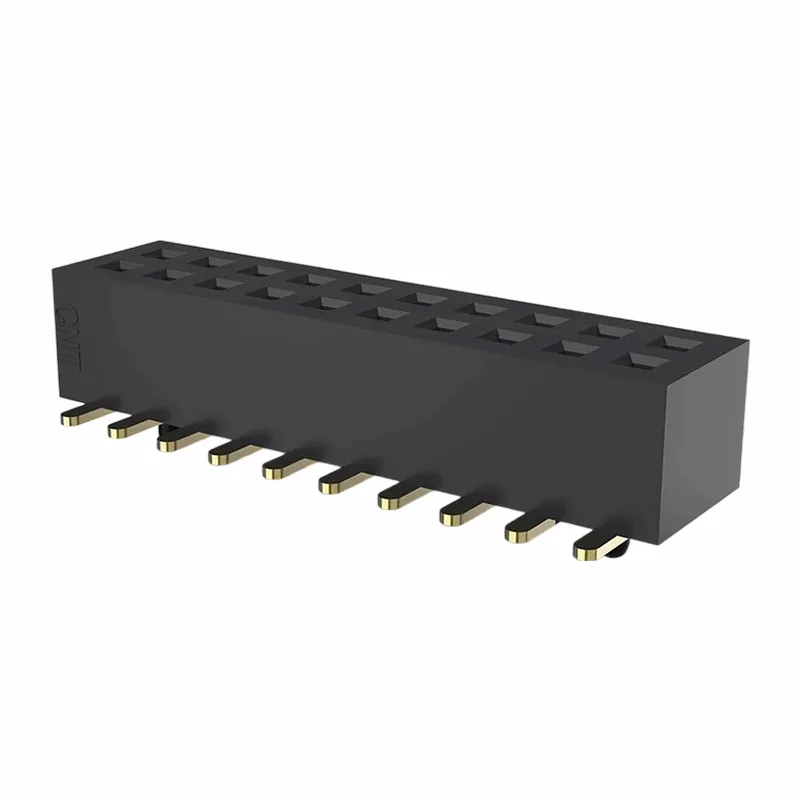
On the other hand, female connectors have sockets or receptacles. These sockets are made to receive the pins from male connectors. Take our 1.27x2.54mm Female Header Double Row Straight as an example. The sockets in this connector are carefully crafted to hold the male pins securely, creating a stable electrical connection.
The way they're used in circuits is another major difference. Male connectors are often used when you need to make a connection that can be easily detached and re - attached. They're great for applications where you might need to swap out components or make quick repairs. For instance, in a modular electronic device, male connectors can be used to connect different circuit boards. You can just unplug the male connector from the female one and replace the faulty board.
Female connectors, however, are usually fixed in place. They're often mounted on a circuit board or a device housing. This makes them ideal for providing a permanent or semi - permanent connection point. When you plug a male connector into a female one on a circuit board, it stays there until you intentionally remove it. Our 0.8mm Female Header Double Row SMT is commonly used in surface - mount technology (SMT) applications, where it's soldered directly onto the circuit board.
Now, let's touch on electrical performance. Male and female connectors can have different impedance characteristics. Impedance is basically the opposition to the flow of electrical current in a circuit. Male connectors, with their protruding pins, might have slightly different impedance values compared to female connectors. This is because the shape and size of the pins and sockets can affect how the electrical signal travels through the connector. In high - speed data transmission applications, these impedance differences can be crucial. A mismatch in impedance can lead to signal loss, distortion, or even complete failure of the circuit.
Another aspect of electrical performance is contact resistance. Contact resistance is the resistance that occurs at the point where the male pin and the female socket make contact. A good connection should have low contact resistance to ensure efficient power transfer and reliable signal transmission. High contact resistance can cause heat generation, which can damage the connector over time. We pay a lot of attention to the design and manufacturing process of our connectors to minimize contact resistance.
In terms of durability, male and female connectors also have their own strengths and weaknesses. Male connectors are more prone to damage if they're mishandled. The pins can get bent or broken, especially if they're subjected to rough handling or excessive force. Female connectors, on the other hand, are less likely to have their sockets damaged in normal use. However, if dirt, dust, or debris gets into the sockets, it can affect the quality of the connection. That's why proper protection and maintenance are important for both types of connectors.
The environmental conditions can also play a role in the performance of male and female connectors. In harsh environments, such as those with high humidity, extreme temperatures, or exposure to chemicals, the choice of connector becomes even more critical. Male connectors might need additional protection for their pins, like a protective coating or a shield. Female connectors need to be sealed properly to prevent moisture and contaminants from entering the sockets.
When it comes to installation, male connectors are generally easier to install. You just need to align the pins with the sockets and insert them. But it's important to make sure that the pins are inserted straight to avoid bending them. Female connectors, especially those used in SMT applications, require more precise installation. They need to be accurately placed on the circuit board and soldered correctly to ensure a good connection.
In the world of industrial connectors, the choice between male and female connectors depends on the specific application. If you need a connection that's easy to disconnect and reconnect, male connectors are a great option. If you're looking for a more permanent connection point on a circuit board, female connectors are the way to go.
We at [our unnamed company] have a wide range of industrial connectors, both male and female, to meet your needs. Whether you're working on a small DIY project or a large - scale industrial application, we've got the right connector for you. If you're interested in our products or have any questions about male and female industrial connectors, don't hesitate to reach out to us. We're here to help you find the perfect connector solution for your project.
References
- General knowledge of industrial connector design and application
- Internal product documentation and engineering specifications