

In the realm of industrial connectors, MDR (Miniature D-Subminiature) connectors have carved out a significant niche due to their compact size and high - density pin configuration. As a leading supplier of MDR connectors, I often encounter inquiries regarding the impedance of these connectors. In this blog post, I will delve into the concept of impedance in MDR connectors, its significance, and how it impacts the performance of electrical systems.
Understanding Impedance
Before we dive into the impedance of MDR connectors, it's essential to understand what impedance is. In electrical engineering, impedance (Z) is a measure of the opposition that a circuit presents to the flow of alternating current (AC). It is a complex quantity that combines resistance (R), which opposes the flow of current in a DC circuit, and reactance (X), which accounts for the effects of capacitance and inductance in an AC circuit. Mathematically, impedance is represented as (Z = R + jX), where (j=\sqrt{- 1}).
The unit of impedance is the ohm ((\Omega)), the same as resistance. Impedance is crucial because it affects the efficiency of power transfer, signal integrity, and the overall performance of electrical and electronic systems. When the impedance of a source, a transmission line, and a load are not properly matched, it can lead to signal reflections, power losses, and interference.
Impedance in MDR Connectors
MDR connectors are commonly used in a variety of applications, including data communication, industrial automation, and test and measurement equipment. In these applications, maintaining proper impedance is vital for ensuring reliable signal transmission.
The impedance of an MDR connector is influenced by several factors:
- Pin Geometry: The shape, size, and spacing of the pins in an MDR connector play a significant role in determining its impedance. For example, the distance between adjacent pins affects the capacitance between them, which in turn impacts the reactance and overall impedance. A smaller pin spacing generally leads to higher capacitance and lower impedance.
- Dielectric Material: The dielectric material used in the connector, which insulates the pins from each other, also affects impedance. Different dielectric materials have different permittivities ((\epsilon)), which determine how the electric field is distributed between the pins. A higher permittivity dielectric will result in higher capacitance and lower impedance.
- Length of the Connector: The length of the MDR connector can also influence impedance. Longer connectors may introduce more inductance and capacitance, which can change the impedance characteristics. In high - frequency applications, even a small change in the length of the connector can have a significant impact on signal integrity.
Typical Impedance Values for MDR Connectors
The typical impedance values for MDR connectors can vary depending on the specific application and design. In general, for data communication applications, MDR connectors are designed to have an impedance of 50 (\Omega) or 75 (\Omega).
A 50 - (\Omega) impedance is commonly used in applications such as radio frequency (RF) systems, high - speed data transmission, and test and measurement equipment. This impedance value is a compromise between power handling capacity and signal attenuation.
On the other hand, a 75 - (\Omega) impedance is often used in applications such as video transmission, cable television, and some telecommunications systems. This impedance value is optimized for minimizing signal loss in long - distance transmission of video and audio signals.
Importance of Impedance Matching
Impedance matching is the process of ensuring that the impedance of the source, the transmission line, and the load are equal. In the context of MDR connectors, impedance matching is crucial for several reasons:
- Signal Integrity: When the impedance is properly matched, there are no signal reflections at the connector interfaces. Signal reflections can cause distortion, attenuation, and interference, which can degrade the quality of the transmitted signal. By matching the impedance, we can ensure that the signal is transmitted with minimal distortion and interference.
- Power Transfer Efficiency: Impedance matching also maximizes the power transfer from the source to the load. When the impedance is mismatched, a portion of the power is reflected back to the source, resulting in power losses. By matching the impedance, we can ensure that the maximum amount of power is transferred to the load.
- Reduced EMI/RFI: Impedance mismatches can also lead to electromagnetic interference (EMI) and radio - frequency interference (RFI). These interferences can affect the performance of other electronic devices in the vicinity. By matching the impedance, we can reduce the generation of EMI/RFI and improve the overall electromagnetic compatibility (EMC) of the system.
Our MDR Connector Offerings
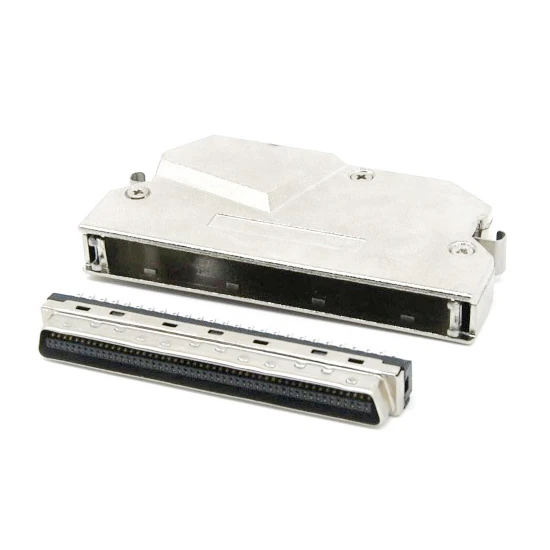
As a supplier of MDR connectors, we offer a wide range of products with different impedance characteristics to meet the diverse needs of our customers. Our MDR 68pin Male Connector With Metal Shell is designed for high - performance applications where signal integrity is of utmost importance. The metal shell provides additional shielding, which helps to reduce EMI/RFI and maintain proper impedance.
Our MDR 68pin Connector is a versatile option that can be used in a variety of applications, including data communication, industrial automation, and test and measurement. It is available in different impedance values to suit different system requirements.
We also offer the MDR 68pin Male Connector, which is designed for easy installation and reliable connection. This connector is suitable for applications where space is limited and high - density pin configuration is required.

Conclusion
In conclusion, the impedance of MDR connectors is a critical factor that affects the performance of electrical and electronic systems. Understanding the concept of impedance, its influencing factors, and the importance of impedance matching is essential for ensuring reliable signal transmission and power transfer. As a supplier of MDR connectors, we are committed to providing high - quality products with proper impedance characteristics to meet the needs of our customers.
If you are in the market for MDR connectors and have specific impedance requirements, we encourage you to contact us for a detailed discussion. Our team of experts is ready to assist you in selecting the right connector for your application and ensuring a successful procurement process.
References
- "Electrical Engineering: Principles and Applications" by Allan R. Hambley
- "High - Speed Signal Propagation: Advanced Black Magic" by Howard W. Johnson and Martin Graham